When the Plastix Madness Hits: Transformation of Sister GlitterNullius X (Final), 2020.
When the Plastix Madness Hits: The Transformation of Sister GlitterNullius (2020) for Plastic-free Biennale, 2020, Lucas Ihlein & Kim Williams in NIRIN, Sydney Biennale. Collaborating Editor: Jesse Tyssen
Exhibited: 2020, Herland III, The Body Resilient, Women’s Library, Sydney. 2021, The Desert Equinox, Broken Hill Regional Art Prize. 2022, Plastic-free Kandos, WAYOUT ArtSpace, Kandos NSW. Script: I got the poison, I got the remedy… The Poison, Prodigy, 1994. http://www.juundaal.com
2021: Cementa Artist Residency, Love Kandos, Kandos, NSW.
Documentation Acquittal Video: Sister GlitterNullius: Love Kandos. My first artist residency: Video documentation with Cementa Inc, Kandos NSW. “Love Kandos” workshops with Sister GlitterNullius. Thankyou: * Wiradjuri First Nations Elders, Custodians and Community, Kandos NSW and Peter Swain, Aunty Di Pirotta, Emma Symes, Aleshia Lonsdale and Theresa Gay. Cementa Inc: Alex Wisser Creative Director/Mentor, Jo Albany, Emerging First Nations Curator, David Ryan, Creative Director and the Kandos community. * Video and editing: Justin Hewitson * Video funding gratefully received from Create NSW, Small Projects Grants. http://www.sisters-of-perpetual-plastix.net Instagram: @thesistersofperpetualplastix @juundaal
2023: Australian Anthropology Society Annual Conference: Presentation.
This presentation was generously funded by Create NSW, Small Project, Quick Response funding category. Wednesday, 29 November, 2023, 25WW C122 Transforming ‘Naturalism’: What might it take? (3) Presentation type: Panel Session * Debbi Long, Earth Care, People Care, Fair Share: Relational Ontologies in Permaculture Theory and Practice * Ute Eickelkamp, From subsistence to biodiversity: The relational space of workers’ gardens in Germany’s Ruhr Valley * Launch of Oceania special issue, Water Futures in Australia: Materialities, Temporalities, Imaginaries. Co-edited by Dr Ute Eickelkamp, Associate Professor Sally Babidge and Emeritus Professor Linda Connor. Launched by Professor Juan Salazar. Presentation type: Book Launch * Juundaal Strang-Yettica, Discussion in the form of an artistic response.
Sister GlitterNullius: Empathy, 2022. Currently on exhibition, FEVER, Wollongong Art Gallery until November 2025.
This video has been made as an utterance toward a large scale, future project for my art practice. Contextual Note: I am developing a proposal to John Kaldor’s Public Art Projects program that eucalyptus trees cut down and wrapped in canvas & plastic by artists Christo (b.1935 – d.2020, Bulgaria) and Jeanne Claude (b.1935 – d. 2009, Morocco), in The Wrapped Coast (1969) need to be repatriated to Country, as a contemporary art iteration of decolonised retro-accountability (Bacon, 2019; Strang-Yettica, 2019). The footage was recorded by Justin Hewitson from time spent on Dabee-Wiradjuri Country, The Common at Rylstone, NSW, during our “Plastic-free Kandos” project, 2022 . This video has been made as part of a performative utterance toward a large scale, future project for my art practice. It is inextricably linked to my Cementa22 performance, “Keeping Gate” & Live Dreams: Performance Space (2022) work, “Bound”. One key aspect of this video, is my characters’, Sister GlitterNullius’ sense of empathy, response-ability, equality, alliance and activism for Nature. As she grapples to understand, assess and enact her contribution to climate justice, cultural revitalisation and decolonisation within the knotted enmeshments of the 21st Century and the Anthropocene, she aligns and equalises herself with Nature. It is the tree who shows her what her work is, supports her (physically and metaphorically) through her journey and gives her, her equality and rest. For the character, although she is not on her own Country, it is one point of recognition/remembering links to her own ancestral lineage and through empathy, finding points to identify herself within her heritage. Spoken in both Bundjalung (not fluent) and English the layering of meanings are enhanced by demonstrating results of dispossession from Country and kin, disruption of Culture, reconnection to culture, cultural proximity. This also points to the need for activism, cross-cultural collaboration and shared knowledges for addressing environmental urgency and understanding animism one path to spirit-kin advocacy for Nature. Credits & Acknowledgements: Dabee-Wiradjuri Country & Community, the Kandos Community, Cementa Inc, WAYOUT ArtSpace, Create NSW (Small Projects), Plastic-free Kandos project: Mentors: Lucas Ihlein & Kim Williams & new project member: Rox De Luca. Indigenous Community Members & Elders, Uncle Peter Swain, Jo Albany (First Nations Curator), Aunty Di Pirotta & Emma Symes, North-East Wiradjuri Cultural Centre, Performance Space: LIVE DREAMS 2022, Mentor/Curator: Alex Wisser, Cementa22 Mentor: David Ryan, Cultural Mentor: Dr. Jodi Edwards, Bundjalung Language, Dez Marsh, Fortitude Illawarra, Client Care First, Video Footage, Justin Hewitson, “Empathy”: Video Editor, Jesse Tyssen.
Acquittal Video: My performances for the Cementa22 Festival were generously supported and funded by Cementa Inc and Create NSW Small Projects Grants.
Cementa Spirit of 21, Sister GlitterNullius: Holy Spirit Sunday School. (2021) Community engagement activity: response to covid-19 fatigue.
Holy Spirit Sunday School: Love You Miss You is my first live-streamed community engagement performance: a practical, shareable workshop, for building emotional resilience during the covid pandemic, combining mindfulness exercises and simple children’s pen & ink games. This is 5 mins of unedited video recording of rehearsal for Cementa’s Spirit of 21, live-streamed festival, October 2021. Tech & Recording: Riley Jones, Cue Cards: Ash Glass. Recorded on unceded Dharawal Country.
Presentation: Assessment 1 CAVA300. Artist: Karla Dickens 2024, Rise & Fall @ Wollongong Art Gallery, NSW. Recorded 15.04.2025 by Christylee Luck, Wollongong. Toward creative practice, hybrid frameworks: – traditional knowledges, – cultural revitalisation – decolonisation, eco-feminism & allied collaboration, – hybrid creatures, hybrid culture & hybrid frameworks, in the Anthropocene.
2020, Covid-19 Confession Reading: A Middle-Aged Biker Confesses His Plastix Waste Sins.
Confession Reading: A Middle-Aged Biker Confesses His Plastix Waste Sins for Plastic-free Biennale, Kim Williams & Lucas Ihlein, 2020. http://www.sisters-perpetual-plastix.net, http://www.plasticfreebiennale.sydney, NIRIN 2020, 22nd Biennale of Sydney. Video: Richard Stalenberg Collaborating Editor: Jesse Tyssen.
Greetings Everyone… A little bit about what I’ve been up to…
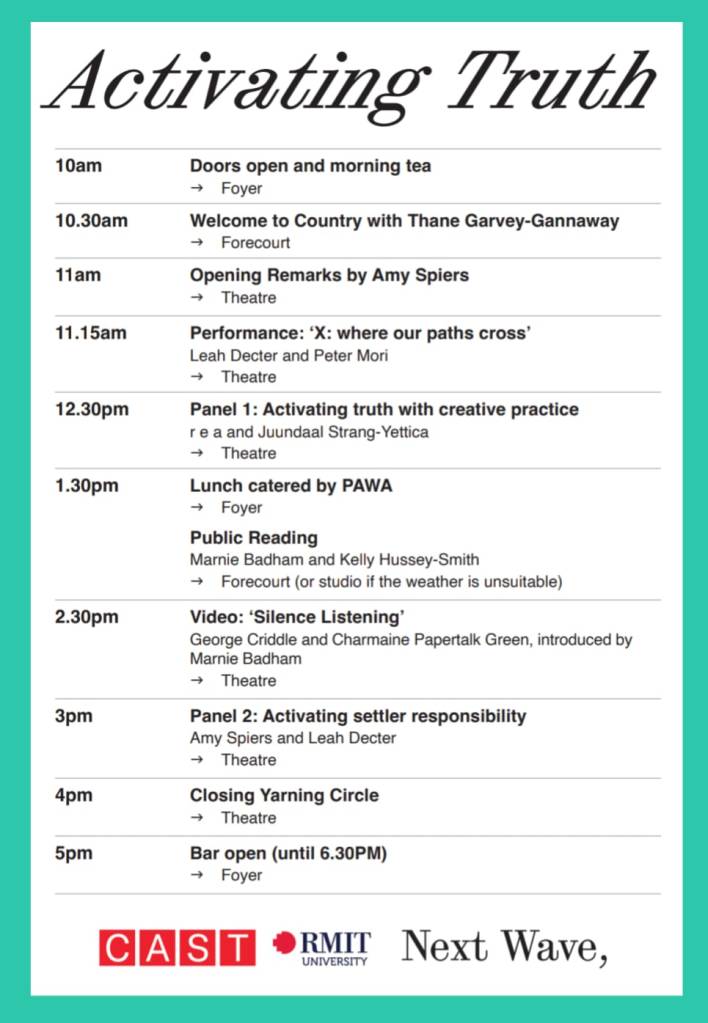
Amy Spiers: Many of us knew each other from a residency last year at Bundanon. Activating Truth is a program of creative research activities bringing together First Peoples and settler artists and researchers from across Naarm/Melbourne, other parts of so-called ‘Australia’, as well as Turtle Island/Canada, to exchange and share knowledge on ways that the truth about settler colonial violence can be activated responsibly and impactfully in community and localised contexts. The idea for the program was instigated by Amy Spiers, and is an attempt to bring a range of separate conversations together on truth-telling and decolonisation through creative practice, and forge stronger partnerships and closer networks that can support, and deepen, all of our ongoing research in this space.
The program occurs at two locations on Wurundjeri Country, and involves a week-long retreat at Garambi Baanj/Laughing Waters 5-11 December 2024, with a one day public program of sharing, knowledge exchange and creative activations at Brunswick Mechanics Institute on 13 December 2024.
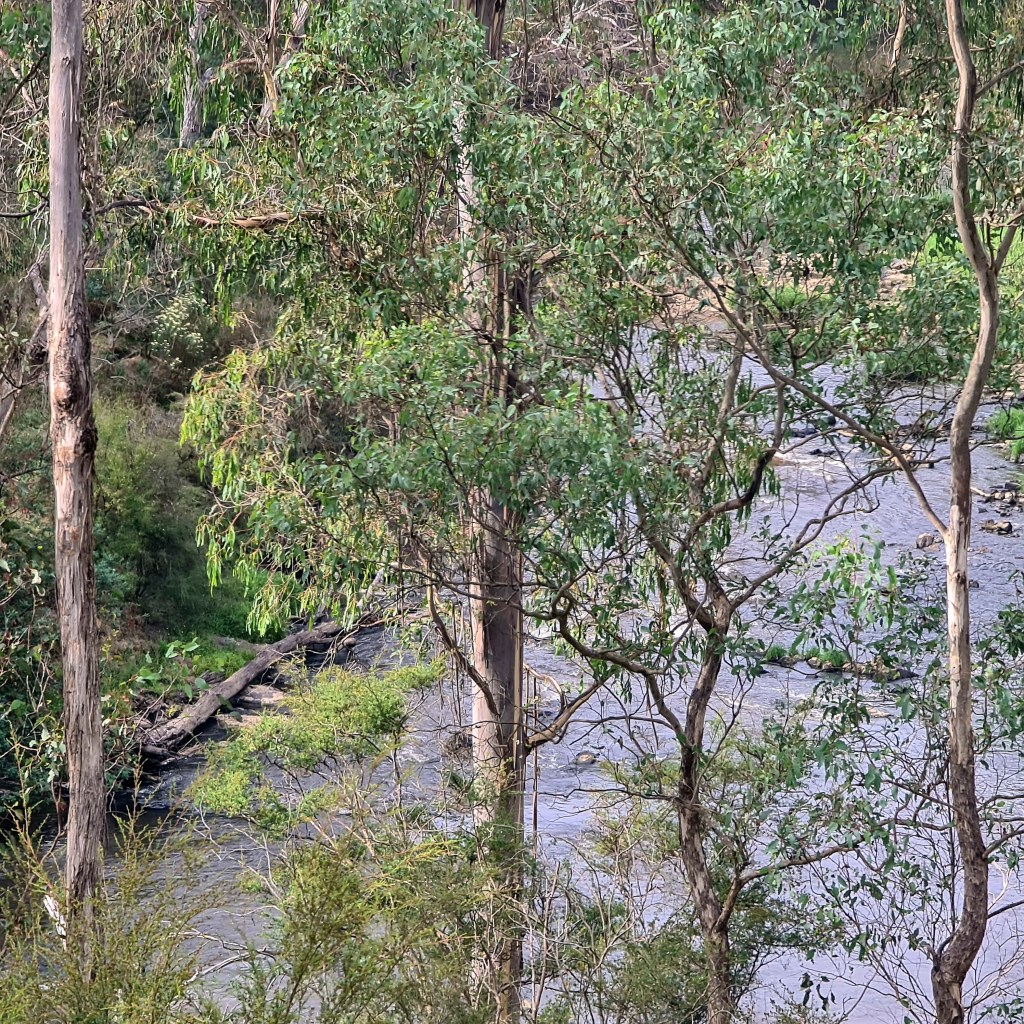
The retreat at Garambi Baanj is beautifully positioned in bush on Wurundjeri Country by the Yarra River near to Eltham, just 40 mins drive from RMIT city campus. The site has enormous cultural value to the Wurundjeri, including an iuk (eel) trap, and Wurundjeri manage the site in partnership with InPlace. You can read more about the history and partnership here: https://inplace.org.au/laughing-waters/.
Brunswick Mechanics Institute is based in the inner northern suburb of Brunswick in Naarm/Melbourne. It is managed by arts organisation Next Wave, and they have kindly offered the space, producing and technical assistance for free for us to hold our public program. Participation in the public program is optional, but it is an opportunity to share the learning and knowledge exchange we have deepened at the retreat with a wider public: https://nextwave.org.au/about/accessibility/visiting-brunswick-mechanics.
Background to the program
Victoria’s formal truth-telling inquiry is currently underway with the First Peoples-led Yoorrook Justice Commission taking submissions and holding hearings about the historic and ongoing injustices committed against First Peoples since the arrival of colonisers in Victoria. Yoorrook aims to establish an official record of the injustices experienced, recommend processes of healing and redress, as well as foster a shared understanding of the impact of colonisation on First Peoples among all Victorians. The burden of truth-telling, however, has been largely left to First Peoples in this process, and it remains to be seen if Victorian settler communities and government will listen to and generate action based on the testimonies shared. We know that related commissions including the Bringing Them Home Report (1997) and Royal Commission into Aboriginal Deaths in Custody (1991) have often resulted in insufficient action. Activating Truth emerges in this context, raising timely questions concerning how First Peoples and settlers invested in the recognition and redress of colonial crimes can draw on interdisciplinary, creative practices to work together to ensure that the true history of Victoria and Australia is shared and heard in ways that activates lasting understanding, transformation and justice.
The program is funded by RMIT University’s Strategic Impact Fund and Amy Spiers’ Vice Chancellor’s Postdoctoral Fellowship Research Fund. Additional support is provided by the School of Art’s Contemporary Art and Social Transformation (CAST) research group.
Jodi Edwards. A proud Yuin woman with Dharawal kinship ties, and VC Senior Indigenous Research Fellow with the Australian National Centre for Ocean Resources and Security (ANCORS), University of Wollongong, Jodi has dedicated her life to Community, Culture, education and Language.
Juundaal Strang-Yettica. Bundjalung and Kannakan contemporary artist, who sometimes performs as Sister GlitterNullius X, ‘a nun, imprisoned by her love-hate relationship with plastix and all things, consumerist, capitalist, catholic and post-colonial’.
Amy Spiers. Settler artist and researcher based at RMIT School of Art examining non-Indigenous artists’ engagements with truth-telling the Australian settler nation through creative practice.
Leah Decter. Settler artist and researcher based at Nova Scotia College of Art and Design (Halifax, Canada) researching critical white settler and decolonial creative practice in the Turtle Island/Canadian context.
Marnie Badham. Based at RMIT University, School of Art (Canadian settler heritage), Marnie’s research sits at the intersection of socially-engaged art practices, participatory methodologies and the politics of cultural measurement.
Polly Stanton. A settler artist working across sound, video and installation and investigates the relations between environment, human actions, and land use. Based at RMIT University, School of Media and Communication.
Paul Mylecharane (aka Milo). A settler graphic designer and web developer specialising in on and offline publishing, including Common Room Editions, a radical imprint that publishes alternative, marginalised narratives and social histories.
Alan Hill. A settler photographer and art-researcher based at RMIT University, School of Art, who focuses on the socially transformative potential of documentary and socially-engaged lens-based practices and education.
Kelly Hussey-Smith. Also based at RMIT University, School of Art, Kelly is a creative researcher of settler descent focused on photography as a social practice, the politics of representation, and art education.
George Criddle. George is a settler artist, writer, and occasional curator based in Naarm/ Melbourne. They are currently collaborating on two projects in Jambinu, Geraldton, WA: an exhibition with Yamaji Elders, the late Dr Brian McKinnon and Charmaine Papertalk Green, titled Silence Listening; and co-producing a Naaguja style opera by singer songwriter Theona Councillor titled Murla-na Bula Wula Bulangul.
Stephen Loo. Based at UNSW, for more than 25 years Stephen has researched, taught and practiced in the transdisciplinary nexus of design, philosophy, art, performance and science.
Clare Land. Clare is an Anglo-identified non-Aboriginal person. She has a long-standing commitment to supporting land justice and Indigenous-led struggles and is known in particular for the book, Decolonizing Solidarity: Dilemmas and Directions for Supporters of Indigenous Struggles (Zed Books, 2015).
Welcome back to the Wrapped Trees Project everyone! I hope you’re all well and groovy!
2024 was an amazing and very busy year! As most of you might know, my technophobia has been challenging but I’ll keep working on it! I have help so, we’ll go back to posting once a week.
Join us for the WORLD PREMIERE public appearance of The TURDIS.
We are partnering with the Wollongong Botanic Gardens to provide toileting services for the upcoming SUPER SATURDAY PLANT SALE.
Time: 730am-2pm
Location: Greenplan Nursery at Botanic Gardens – enter via 65 Northfields Avenue, North Wollongong.
The TURDIS is an innovation of the Pootopia research group at University of Wollongong.
Design by Kim Williams
Construction by Kim Williams and Lucas Ihlein
This project brings together art, engineering, and economics to investigate the impact of human manure composting.
On 2 November 2024 the Pootopia team will showcase a new toileting experience – THE TURDIS – an attractive, quick-assembly unit, servicing on-site events.
With THE TURDIS your poo and wee makes soil, not pollution!
THE TURDIS – choice of time-lords across the galaxy!
“I abhor chemical portaloos! Whenever I time-travel, I choose THE TURDIS” – Dr Poo.
The construction of THE TURDIS was supported by a grant from Culture Bank Wollongong.
The Pootopia project is funded by University of Wollongong’s Global Challenges program.
Graphic design for the TURDIS publicity material is by the John “Bristol Stool Chart” Causley.
Good afternoon Tree Guardians! Thanx for stopping by!
Today we have a call for petition signing, from Tree Guardian, Shelley Watters for the Inner West Council. There are also some Q & A’s below.
Inner West residents, please sign the petition to Inner West Council as they have no targets regarding local native plants on verges and street gardens. They have got a draft Biodiversity Strategy live and it’s a great time to show them how residents support planting endemic species.
The petition aims to put pressure on the streets and parks people/team who just plant turf and mow over native grasses/gardens. We need to up the ante and be active in urban ecology regeneration!
The petition will close be on 31 October, so it can be discussed with the other public feedback while the draft strategy is on exhibition.
A few things to note/common questions I’ve had:
Q: are you suggesting we remove all existing lawn, trees and plants from verges and street gardens?
A: NO WAY! The petition proposes that by 2036, endemic natives are the default choice for public space in the Inner West Council LGA. That plants or gardens requiring replacement due to natural attrition are replaced with endemic species as the first preference.
Q: What about when introduced tree species provide more shade than native trees?
A: Existing trees on our streets shouldn’t be removed for natives, but given the wide range of native species in the ecological communities of the Inner West, there are usually great native choices. But Council will make a choice in this situation and if there truly are no native trees that compare then I support shady streets that support all human and non-human requirements for life, I’m aiming to shift the needle to make natives the default in public space.
Q: Are you suggesting that no one can plant any fruit trees? Native wildlife really love to eat the fruit from my tree.
A: Private property owners can plant productive and introduced species as usual (I do love all plants!)
Q: what about when climate change impacts what natives will survive in the Inner West?
A: We definitely need to consider the impact of a changing climate. Many, many of the species from the Sydney Turpentine-Ironbark Ecological community are found within other forest communities up and down the east coast. I leave the responsibility with Council to determine the best native species for verge plantings as we experience more of the impacts of climate change. Obviously, we want species that will survive and thrive and need to adapt to the mess we’ve made so far.
Q: Council already has a policy where residents can maintain their own verge gardens. What does your petition mean for us?
A: It’s so awesome that Council’s current policy has been encouraging those with time and resources to take responsibility for individual verge gardens. The Living Streets team encourage the planting of endemic natives by providing verge plants for free to registered Living Streets gardeners. This will continue in parallel with what I propose as Council Parks & Streets staff learn how best to manage native plantings rather than running a mower over everything.
The petition asks that as Council are already responsible for the verge gardens – why don’t they be MORE responsible, and habitat focussed, rather than thinking only about short-term efficiency.
I had the privilege of attending this screening and would like to share Fiona’s work with you: FIONA DAVIES SCRIPT ‘Once Upon a Time, Long Ago and Far Away: The Pale Horse of Death’.
FIONA DAVIES’ SHORT FILM ‘PALE HORSE OF DEATH’ –
GOLDEN AGE CINEMA SCREENING
Following successful previous film screenings (2019 & 2023) at the Golden Age Cinema & Bar, multidisciplinary artist Fiona Davies has returned with the newest work in this series – Once Upon a Time, Long Ago and Far Away: The Pale Horse of Death, to be screened on Wednesday 11 September., 2024.
Influenced by three extraordinary films, The Seventh Seal (1957) directed by Ingmar Bergman; The Color of Pomegranates (1969) directed by Sergei Parajanov; and Testament of Orpheus or Do not ask me why (1960) directed by Jean Cocteau- the artist has drawn upon the idea of death challenging the patient to a contest of some sort; the format of visual and spoken word brevity; and the horse as part-costume/part-independent/part assisted by a human to form shape. The short film ‘Pale Horse of Death’ is situated in a delirious state of high impact gaming. A patient in ICU meets Death and is challenged to a contest. The prize is unknown. In this beautiful, emotional rendition of the interplay between panic and boredom, we see the power of mythology interacting with the sterility of the contemporary ICU. This is an obstacle race, a game on horseback. It is a study of loss. With reference to the riders and horses of the apocalypse ‘Pale Horse of Death’ also makes use of religious metaphors such as the parable and is laden with the horses own societal connotations. This short film is a development from a previous work shown at Cementa 2022 that responded to the 2019/2020 bushfires and the relationships between people and horses particularly in times of extreme danger, emotion and competence. In that iteration, the artist wanted to capture the strength of emotion that blurred the boundaries between horse and owner overlaid by the grief and mourning that came from the loss of so many animals. Davies made works that could be seen as theatrical costumes, fancy dress outfits, or rumbustious carnival costumes that combined the head and shoulders of a horse with a cape that either covered an absent two legged body or when the dandified stallions wore their capes theatrically swept back over their shoulders, they exposed to view a two legged body wearing evening gloves of satin and beading on their front limbs. The mares and foals seemed to wear their capes for warmth and protection and eschewed satin and beading for ease of movement and escape. The horses were hung from the oval steel rail by a meat hook through the top of their heads. Also hanging on the rail that referenced the merry-go-round, the racetrack, and the abattoir (all sites where the power of the horse is subjugated) was a delicately embroidered blouse that the artist’s mother used to wear. Very small dark blue horses still pranced with enjoyment down the front placket of the blouse. Driven by the narrated script delivered in an intentionally dead-pan manner, the short film consists of footage of a patient in ICU bleeding out internally, hospital interior images, horses in movement and large-scale marionettes.
The film is not a direct visual translation of the narrated story. The viewer is left and is afforded space to come to their own interpretations of whether what they hear and see is humorous or disturbing, and arrives at their own understanding of this study of loss. The artist is enlisting the drama of the cinematic experience – being alone and yet being in a group all in the dark. The audience is not shown anything shocking, rather the artist is looking to build up layers of apparently conflicting emotional responses. The seesaw between panic and boredom and dread. The video is set in an ICU but there is no overt presence of the medical. Rather the film could be seen to only exist or be set in the minds of the patient/death and us. Employing the character ‘we’, ‘Pale Horse of Death’ is an attempt to disrupt the separation between the character of the patient and the viewer sitting in the cinema. ‘We’ are all complicit. ‘We’ are all involved.
Fiona will be screening ‘Pale Horse of Death’ again in 2025, and in December will be furthering her film works at Gallery Lane Cove, with a sound piece titled ‘The Night’, drawing from a paper the artist wrote for Ethnologies (Issue Vol 44 No 1) ‘Nocturnal Ethnographies: Aesthetics and Imaginaries of the Night,’ a journal published with the financial support of the Social Sciences & Humanities Research Council of Canada (SSHRC), the Fonds de recherche du Québec – Société et culture (FQRSC), and with the collaboration of the Interuniversity Centre for Studies on Letters, Arts and Traditions (CÉLAT) of Laval University.
For Media & Press Enquiries please contact: Su-Wen Leong [REPRESENTED X SL] SL@RepresentedXSL.com 0411 627 937
Chapter One: We can see the patient lying flat on their back on a hospital bed. They are being mechanically ventilated. They are in ICU. They are wearing the uniform of the patient. They don’t feel safe. We don’t feel safe either. We worry that they will take a turn for the worse. We are told that the patient is stable and settled, and we should get something to eat and take some fresh air. We walk from the light out into a darkened corridor. As the door closes, we see and hear that Death has appeared and has challenged the patient to a contest. It is to be a difficult obstacle race. Death has added an extra rule. All the tasks must be done on horseback Death has decided to ride the Pale Horse of Death, who has a proud lineage. Pale Horse of Death is the child of famine who is the child of infection, who is the child of pestilence, who is the child of despair, who is the child of loss, who is the child of loneliness, who is the child of the sword, who is the child of war. The Pale Horse of Death wants to win. It is fed up with being the last to come on after the other three horses of the apocalypse. Death tells the patient a bedtime story. It is the story of the great grandparent many times over of the Pale Horse of Death. The story follows the horse on a journey seeking a King. Death reads from Culhwch ac Olwen. The speed of that horse was great, ‘as they rode four clods would the hooves of this horse cut [from the turf], like four swallows in the air above their heads: sometimes above, sometimes below’. The care of that horse was great – ‘the tips of Culhwch’s hair would not stir: so light [was] the canter of the horse’. The beauty of that horse was great – a light-grey headed horse: four winters strong with a well-knit fork; shell-hooved with a golden tubular bridle-bit in its mouth.’ We are terrified. The patient doesn’t understand what is happening. They don’t know where they are and who is with them. They are not stable and settled. We aren’t either. None of us have ever competed in an obstacle race let alone one on horseback. The patient has been re-assessed. It has taken a long time. They have tried to take the patient off mechanical ventilation. It wasn’t a success. The patient became very agitated and unstable. The patient has ICU delirium. They have used the Confusion Assessment Method to rate the severity. The medication for the patient is to be changed. The smell of the hand sanitiser is strong. It is overwhelming the smell of horse.
Chapter Two: The patient’s life is undone. They are sedated. They can’t move. We think they can hear. We can see the patient’s thoughts floating around them. There is a buzzing noise as they appear out of and again recede into a thick fog. They can hear the ring of the bell to start the race, the swish of the dropping rope. We can also hear the thrum of racing hooves. Then the bedside monitor alarms. The racing horses come back. Now, there is a train in the room and the sound of danger. We can’t tell one from the other. The patient can feel a foggy outline of something lying beside them. It gradually forms. Right there is the steaming body of a palomino. The horse blows next to the patient’s ear. The patient smiles. They feel reassured. They have a horse and may have a chance to win. The patient asks the horse about its heritage. Who were its parents, grand-parents and great grandparents. The horse doesn’t know. It was rescued in a dehydrated state during a drought at the age of four months. It doesn’t know its birth name. It was given the name Caramel by its rescuers. The horse doesn’t think the colour of its coat reminds anyone of the colour of a good caramel. It is rather the colour of an overcooked fudge. We ask the horse if it thinks it is descended from Trigger. It says no and that that comment is not funny. ‘I am a drinker of the wind, a horse of the desert, of tribulation, of war and of the stoic.’ The patient says I don’t think Arabian horses can be palominos. The horse replies ‘I can be what I want to be, but I do not know my name and I do not know the names of my parents nor of my grand parents’. Death appears and looks the patient’s horse over. Death picks up its feet and examines its hooves. Death is not impressed. Death tells the patient of one of the tasks in the race. The patient feels sick. We feel sick too. Death says sewing has always been one of their skills so that must be included. What does the patient think? We know this is not a negotiation. We know Death is very good at sewing a running stitch. The patient says they are better at blanket stitch. Death says, ‘so we’re agreed on running stitch then’. The patient suggests the task of finding drinkable water. Death is not interested. They don’t drink water and don’t see the need to find it. Death lists other tests of fortitude and skill – standing on one foot, juggling three oranges, rescuing another horse from a stable fire, drinking from a glass while galloping. The patient pushes Death away. They are tired of hearing Death say of each task ‘Easy it is for me.’ We are tired of it also. Death sits on a chair in the corner. They get out a small piece of cloth and start to practice sewing a fine and even running stitch. The thread is white, and the cloth is blue. The patient is asleep. They are restless and mutter about horses. We bring in a copy of Black Beauty to read to them. We also show the patient the pictures in the book even though the patient’s eyes are shut. We got the book as a prize for the most improved in fifth class. We’d forgotten how unfair the story is. It starts out well and then goes downhill fast. Fire, unkind treatment, ignorance, drunkenness, and the threat of being sold on to someone even worse. We edit those bits out as we read. The patient is conscious. They talk to people they see in their room, walking around even walking through walls. None of them reply to the patient. The patient becomes more anxious at being ignored. The patient shuffles in the bed. They have been restrained. The skin of the patient is turning to a pale green. Not the green of fresh grass, nor of the gum leaf, nor the green of unripe grain but the pale green of decay and mould. They are scared. The obstacle race hasn’t started. They are scared Death has forgotten them and has let the Pale Horse of Death out into the paddock. They are scared they will not be able to win this challenge. That they didn’t have a chance.
Chapter Three The patient has been left alone. The horse Black Beauty is waiting for them. They will ride and ride until they find a small running stream. They have forgotten Caramel.
Images: Fiona Davies, ‘Once Upon a Time, Far Away and Long Ago – The Pale Horse of Death, (2024), Film Stills, Courtesy the Artist. The End .
Good afternoon everyone, thank you for dropping by this week! I had the distinct privilege of joining one of the workshops for this collaborative exhibition by our Tree Guardian, Tom Isaacs and Nuno Rodrigues de Sousa in August.
‘In The Flat Field’ is a collaborative exhibition inspired by the novel Flatland: A Romance of Many Dimensions by Edwin A. Abbott–a satire set in a two-dimensional world populated by geometric figures. The exhibition includes 2, 3, and 4D artworks exploring speculative connections between Modern art, science and mathematics, and science fiction. Please enjoy some of the workshop photographs and the following essay, Geometry, Kinship & Juxtaposition, João Seguro.
Geometry, Kinship and Juxtaposition
João Seguro
“…each geometry projects its own history in return.”, Michel Serres
Flatness has been an omnipresent attribute in visual arts discourse since modernism. According to its main proponents, painting should develop strictly on the two-dimensional plane in order to avoid problems that would be alien to its discipline and its nature; the same should apply to other traditional artistic disciplines such as drawing and sculpture. All possible approximations between the fields of work should be avoided in order to bring Painting closer to its essence, or, as Greenberg puts it in his influential essay, to its purity.
For Greenberg, this purity was the main objective of modern painting. To achieve this goal, painting had to focus on its flatness in order to work on the formal and material properties of the medium of painting, the specificity of the métier, and commit to the absolute suppression of the mimetic characteristics that art had pursued for millennia. This essentialist vision of art defined much of what we know today as Modern Art.
It is based on the legacies and traces of the procedures of this type of modernism that we can start an itinerary through this exhibition – In the Flat Field – a joint project by artists Tom Isaacs and Nuno Rodrigues de Sousa.
Tom Isaacs and Nuno Rodrigues de Sousa are artists in whose work we can find reverberations of these modernisms, although the questions their practice pursues are often contrary to the decorum that characterises the essentialism of formalist modernism. The work of both artists is often permeated by elements that graphically refer to morphological elements of the historical avant-garde of modernism, but it is clear from the outset that what is sought, despite the direct influence, is a historical and discursive scenario that favours the construction of fictional and speculative scenarios full of critique and irony. And it is precisely through the critical nature of quotation and humour that this exhibition develops.
We can start questioning the name of the exhibition, which is an amusing tautological allusion – In the Flat Field is the title of a song and album by the fabulous rock band Bauhaus, which in turn borrowed its name from the mythical German art school, one of the paradigmatic moments in the history of modernism and the place where many of the works and theories that inform the work of the two artists were developed. What’s more, we mustn’t forget that the Bauhaus has many similarities to Vkhutemas, another very important art school that operated in Russia between 1920 and 1930, after the influence of several of the authors mentioned in Isaacs and Sousa’s work. It’s therefore a title full of wit that supports countless layers and historical intersections.
But this title, although revealing, is also accompanied by a drawing (which is the image on the exhibition invitation and the first “work” in the exhibition complex with which visitors may have had their first visual contact) that evokes another work and complexifies the network of relationships that we will come across in this exhibition. The drawing is a visual quote of the frontispiece of Edwin A. Abbott’s book Flatland: A Romance of Many Dimensions, a work that serves as the backdrop to this exhibition and the set of juxtapositions rehearsed here.
Entering the exhibition, we find a group of works where the flatness evoked by the title and context of the book intersect with the multiple dimensionalities inherited by the works and contexts of modern art.
After passing through the gallery’s green doors, we are greeted by four small works – facing us, The Inner Eye of Thought and St Joseph by Tom Isaacs, ironically underline the ocular centric and illusory character of art, as well as its potentially redemptive quality. The iconography and materials used by Isaacs in these two pieces highlight the web of relations of affinity and intertwined lineages that assert themselves in this exhibition as a ghost inhabiting official histories.
On the heels of these pieces come two works by Rodrigues de Sousa – The Lost Isosceles and Where are you, son?, enigmatic pieces that suggest the regime of approximations between the narrative of the literary work cited and the artistic narratives from which the works of the two artists will unfold. Between the diagrams of Flatland and the modernist shaped canvases, Nuno Rodrigues de Sousa opens up a terrain of mirrored references that challenge us through the refraction of multiple dimensional beings observing each other, an allusion to a psychotic Mirror Stage where there is no time or space, because there is no present or past and geometric and spatial figures take on human features.
In Vitruvian Ghost, Nuno Rodrigues de Sousa proposes a stroboscopic projection of a square framed in a circle (a metaphor for the noblest class of beings in Flatland). The black and white of the high-speed light projection distracts us from the black square that is integrated into the circle, or is it the circle that incorporates the square? Apart from the multiple cultural references the work seems to contain, we are faced with a kind of Venn diagram that gives us another clue as to the cannibalistic regime of the exhibition project. We are at the same time inside an art gallery and at an unknown space where the creatures of the fiction narrated by A. Square dwell.
Next door, Monolith/Messenger by Tom Isaacs points out some derivations of black squares, the history of monochrome painting, painting as an object and its performativity, as if paving the way for the projection of Neo-Therapeutic Operation, a video in which the two artists collaborate in altering a square canvas (the configuration of the narrator of the story and the tutelary form of Constructivist and Modernist art), as if it were a surgical operation, sectioning it until it becomes a sixteen-sided object. This piece addresses the troubles of forced adaptation, a certain evolutionary morphology of human society that also has echoes in Abbott’s book.
Above the entrance door to the gallery, The Black Pentagon by Nuno Rodrigues de Sousa seems to be watching us. Here, Malevich’s black square is transformed into this shape and, by being placed at this spot also transforms its condition as a painting. It ceases to be a passive object for observation and suggests a renewed ontology of the observer by replicating the black of the CCTV cameras we can usually find in the corners of public buildings. The painting moves from being the place of the observed to become the intrusive place of the observer, placing the gallery visitor as an active element of the spatial device.
Flanking the flight of stairs that gives access to the second room of the exhibition there are two sets of drawings, The Flat Characters on the left and The Irregulars on the right. Remembering that in the world of Flatland there are no irregular polygons, we imagine that we are entering a world where the regular figures of Abbott’s parody are perverted by an extrinsic imagination that expands, or at least opens up the possibility of expanding, the world of his figures to other dimensions and sociopolitical ecosystems. Some of these irregulars resemble drawings we know well – it’s no coincidence… Still on the wall of the access staircase, two of the small figures from Father and Son by Nuno Rodrigues de Sousa, which will be replicated on other places later on, refer to the piece in the first room Where are you, son?; the father continues to circulate through the spectator’s space in search of his son, making this piece a kind of performative painting that circulates and makes us circulate through the exhibition space in search of its limits and its conclusion.
Curiously, going down the stairs on the right, a new black square by Tom Isaacs entitled Mum and Dad switches things up, the contrast between a sewing needle and the black fabric of the painting being decisive, as if to suggest a duality and/or complementarity and introducing a variant of kinship (personal or figurative?) that intersects with the fictional kinship of the characters in Flatland. This piece, like the other two adjacent pieces by the author, made of fabric, and with enigmatic titles such as Homage to the Hypercube and Counter-Composition: The Argument from Analogy offer a commentary on the rigid structures of modernism, their geometric and fixed modularity, although in these the spatial elements, movement and the dimension of uncertainty are some of the keys for the interrogation. The same seems to be true of Nuno Rodrigues de Sousa’s mural The Rebellion of the Isosceles. In this piece, the artist once again fuses the universes of modernist artistic practices and the geometric shapes found in Flatland, red triangular figures orientated towards a circle, or, thinking in our complex of equivalences – soldiers – towards a tutelary figure, the highest in the system of Flatland, represented by the circle. If we look at this piece away from that system, we can think of a lot of post-war French painting, the escape from structures, the metamorphosis of forms, the play of form/figure/background, typical of the proposals of the Supports/Surfaces group.
The other works in this gallery add to this game of juxtapositions and enigmas – three sculptures by Tom Isaacs on plinths advance three-dimensional geometric structures – a black cube titled Melencolia seems to play with the three-dimensionalisation of a square while surreptitiously quoting Albrecht Dürer’s piece of the same name; the plinth in turn is invaded by two pieces (Father and Son) by Rodrigues de Sousa, further increasing the scheme of tensions and intersecting spatial regimes. The other two pieces are Chariot and Hypercorpus, both of which indicate the spatiality and temporality of objects as a disruptive historical complementarity of modernity.
To conclude the exercise of going through and interacting with the objects in this exhibition and the kaleidoscopic radicality of this superimposition of images and objects, another shaped canvas, Homage to the Pentagon, by Rodrigues de Sousa, makes the figure of the pentagon reappear, omnipresent in various configurations throughout the space. This wall piece mirrors another pentagon on the floor, on the other side of the room, Maze Prison. As the name suggests, it’s a labyrinth, where other small pentagons and squares try to find their way out.
These shapes take us back to the beginning of the exhibition and to the multiple self-referentialities and extra-territorialities that are possible to find. Squares that aren’t just what they are, pentagons that aren’t what they seem to be, circles with second and third intentions (or dimensions), lost figures, others that fit in, or even some that run away, still others trying to find their way out, or forced to be what they are not.
João Seguro
1. Serres, Michel; The universal and the differences in Geometry – The Third Book of Foundations, Bloomsbury Academic, London and New York, 2017, p. XVI.
AboutTom Isaacs: Tom Isaacs (b.1985, Oxford, UK) is a contemporary artist, educator, and academic living on Wallumedegal land, Sydney. Tom’s recent solo exhibitions include: ‘In the Flat Field’, 2024 (collab. with Nuno Rodrigues de Sousa) at Chrissie Cotter Gallery, Camperdown, supported by the Inner West Council; and ‘Ad/dressing the Wound’, 2023 at Ellipsis Gallery, Woolloomooloo, supported by the NSW Government through Create NSW.
In his artistic practice, Tom explores themes of mental health, wellbeing, care, and the profound importance of human relationships and connection. He draws inspiration from diverse sources, including psychoanalytic theory, philosophy, poetry, religious and ritual practices, and art history. Tom employs a range of mediums in his artistic practice and is best known for his use of performance and textiles. In recent years, he has been exploring participatory and socially-engaged modes of art practice which engage audiences in the process of art making. This exploration has been supported through his involvement in year two of CASE Incubator, a professional development, knowledge sharing and mentorship program led by the CAD Factory.
In 2022, Tom completed a PhD at Sydney College of the Arts, the University of Sydney. His PhD research concerned the relationship between ritual, psychoanalysis and body art, and how these different streams of thought address the problem of alienation. Since 2022, he has taught a range of subjects at the University of Sydney, including Art History, Performance Studies, and Visual Arts. In the last year, Tom has delivered presentations as part of Louise Bourgeois: Tides and Currents at the Art Gallery of NSW, Archives, Artists & Absences, the 2023 ADSA annual conference in Adelaide, and the Alana Bowden Memorial Seminar at the Chau Chak Wing Museum, the University of Sydney.
Tom says of his work: My work creatively and critically engages with ideas of mental health, wellbeing, care, and healing. My practice is informed by my lived experience of neurodiversity, depression, intergenerational trauma, and psychotherapy, and my interests in psychoanalytic theory, art history, religion and ritual practices.
Performance art has long been a way for me to process and express something of the experience of living with depression, with regular references to melancholia, repression, and death, but also to healing and rebirth. One recurring motif that embodies this ambivalence in my work is the covering of the body with wool or felt fabric which evokes funeral shrouds and burial rituals, but also the work of German artist Joseph Beuys who claimed to have suffered life-threatening injuries which were healed by wrapping his body in fat and felt.
In 2020, inspired by my mother’s quilting practice and by the idea of quilts as practical expressions of love and care, I began to make textile works using felt. While developing Emergency Blankets for Cementa22, I travelled to Kandos several times to sew with members of the local craft group. This experience impressed upon me the power of making together as a potent combination of creative practice, relationship building, caring, and community.
Since then, I have been researching and experimenting with interactive, collaborative, and socially engaged modes of practice. I am currently developing a socially-engaged project exploring the benefits of creative embodied practice for mental health and wellbeing, with a focus on ethical, non-hierarchical relationships and open-ended creative process https://tom-isaacs.com/about/, accessed: 09.09.2024.
I hope you’ve enjoyed the blog! Thank you for stopping by everyone! Take care of each other!
The manifesto message:The Wrapped Trees Ten CommandmentsManifesto (Catholic Diocese of Melbourne, 2011; Strang-Yettica, 2024), calls for Aboriginal and non-Aboriginal collaboration, repatriation and retro-accountability (Carlson & Frazer, 2018; Christen, 2011; Strang-Yettica, 2019), in decolonisation frameworks. The manifesto is acknowledging non-human equal rights and allyship within intersectional environmental frameworks (Christen, 2011; Davis & Turpin (eds.) 2015; Edwards, 2020; Giblin, et al, 2019, Haraway, 2016; Todd, 2015 Tsing et al, 2017). Key elements of the Manifesto call for Aboriginal cultural revitalisation, cultural repatriation, and interrogation of the digitalocene, changed individual and institutional environmental and socio-political ethics, policies and behaviours (Carlson & Frazer, 2018; Christen, 2011; Davis & Turpin (eds.) 2015; Giblin, et al, 2019; Edwards, 2020; Schultz, 2013; Strang-Yettica, 2022). The primary aim of the Manifesto (Strang-Yettica, 2024) is to recruit communities and collaborators from various disciplines, backgrounds and abilities (Carlson & Frazer, 2018; Christen, 2011; Davis & Turpin (eds.) 2015; Edwards, 2020; Haraway, 2016; Schultz, 2013; Todd, 2015 Tsing et al, 2017). to act and join The Wrapped Trees, an environmental and socio-political, superhero justice league, into an arts-lead social change project The Manifesto not only identifies capitalism, colonialism, consumerism and Christianity, as being at the centre of environmental and socio-political disintegration, it also aims to activate multiple, possible and practical, simultaneous solutions that could be achieved, individually, collaboratively and institutionally (Carlson, Bronwyn & Frazer, 2018; Davis & Turpin (eds.) 2015; Giblin, et al, 2019; Haraway, 2016; Schultz, 2013; Todd, 2015 Tsing et al, 2017). Key motivations underlying this Manifesto are the need to address climate crisis, restructuring human, and non-human relationship, (Haraway, 2016; Todd, 2015; Tsing et al, 2017) and strengthen non-Indigenous and Indigenous relationships through decolonisation strategies, simultaneously (Carlson, & Frazer, 2018; Davis & Turpin (eds.) 2015; Giblin, et al, 2019; Schultz, 2013; Todd, 2015; Tsing et al, 2017). With a sense of urgency, other motivations of the Manifesto include hope, co-care, retro-accountability, inclusion, diversity and the need for enacting equal, multiple communities, disciplines, approaches, simultaneously and collectively to achieving arts-led environmental and socio-political change (Davis & Turpin (eds.) 2015; Giblin, et al, 2019; Haraway, 2016; Schultz, 2013; Todd, 2015; Tsing et al, 2017; Strang-Yettica, 2022).
Conveying the manifesto message: The Wrapped Trees 10 Commandments (Catholic Diocese of Melbourne, 2011; Strang-Yettica, 2024)are presented as a performance, written from the perspective and represented by my performative character, Sister GlitterNullius X, (Schultz, Tristan B, 2013; Strang-Yettica, 2020). The Manifesto was presented within the tutorial context, in character as a preaching sermon. This style of delivery was chosen as the most effective to strengthen impact and further layer the Manifesto’s call to action and meaning. Delivering the Manifesto in character was a strategy, to more theatrically engage the class, personalise its content and elicit more powerful emotional responses. This format also allowed for video documentation for reflection and use in the future. Both my character (Strang-Yettica 2020) and The Wrapped TreesProject (Strang-Yettica, 2022) are part of my ongoing art practice, and this assessment task provided the opportunity to further develop the character and my project’s Manifesto. Sister GlitterNullius X (Strang-Yettica, 2020), has existed as an element of The Wrapped Trees (Strang-Yettica, 2022) since I began the project two years ago, including a written open letter on the Project’s site. CACS200 student, Jasmine-Maree Takchi and I utilised the assessment opportunity to collaborate on video documentation, editing and reviewing each scholarly statement prior to submission.
Engaging with the manifesto form: While the Manifesto contains Ten (10) Commandments (Catholic Diocese of Melbourne, Exodus, 20, 2011; Strang-Yettica, 2024, I adapted and combined different Commandments to present four (4), to remain within the class context and presentation time allocated. I wrote and performed the Manifesto from the perspective of my character, Sister GlitterNullius X (Strang-Yettica, 2020) to strengthen the form, engage more creatively with the content and contribute more comprehensively to its meaning, delivery and audience engagement. Deploying the character to deliver the Commandments (Catholic Diocese of Melbourne, Exodus, 20, 2011; Strang-Yettica, 2024). In my Manifesto performance, typical manifesto characteristics were deployed. I used a combination of theatre, multiple creative forms including a character preaching, a short numbered list, provocation, repetition and blame to strengthen audience engagement. I utilised the character, Sister GlitterNullius X (Schultz, 2013; Strang-Yettica, 2020), a fiction dressed as fact, to embrace the paradox, depicting environmental crisis as the precipice for extinction. The Manifesto offers strategies for resolving the crisis via the formation of a superhero justice league (Schultz, 2013; Strang-Yettica, 2022), introducing an element of magic. SJ Norman’s (2021), Liturgy of the Saprophyte is a key influence upon my Manifesto and other aspects of my performance, written and collaborative work. Like SJ Norman’s work, my Manifesto calls for learning from and equalising the rights of non-human kin with those of humans. Like Hugo Kant’s, I don’t want to be an emperor, (2011), my Manifesto calls for a reorganising of social structures, a superhero justice league of intersectional environmentalists, rather than a society that upholds individualist notions of stardom or fame (Norman, 2021).
Good afternoon everyone! Thanx for stopping by. I saw Ben Denham’s work recently at the SCA Galleries and thought you might be interested in this aspect of it. Links to all the artists sites are at the end of the post.
Pressure gradients form an ever-shifting topography of air, a topography patterned by the earth’s rotation on its axis and the Sun’s cyclic heating of air, land, and ocean.
The pressure waves that are the consequence of the spinning earth and it’s proximity to the Sun are a tidal phenomenon with a 12 hour cycle. When the ‘noise’ of the weather is removed from the signal of cyclic heating, plotting the daily pressure fluctuations reveals a sine wave, with a maximum amplitude in the tropics, where more of the Sun’s energy reaches the surface of our planet.
Figure 1: Average pressure fluctuations about a daily mean pressure due to atmospheric tide for stations along the west coast of India (around 15° N), near the equator in the Maldives Islands, and in the English Channel. Source: Article by Frank LeBlancq in the Journal Weather, Volume 66, Number 11 (November 2011), published by the Royal Meteorological Society.
Topographic Mapping
The isobars on a weather map link areas of equal air pressure in a way that is analogous to contour lines linking areas of equal altitude on a topographic map. The closer the isobars, the steeper pressure gradient, the stronger the wind.
The map offers generalisations that serve the purpose of prognostication, navigation, and planning. The topographic map describes features that you can see, both on the map and in the terrain.
The isobars on weather maps describe an aerial topography without fixed reference points. We see the visual form on the map, we feel pressure gradients on our skin. We swim in this topography of air, our bodies sensing its pressure changes; from shock waves, to cyclones and hurricanes, to gale-force winds, from a fresh to a light breeze, to a zephyr caressing the back of your neck, from air moving with intricate subtlety at the finest edge of your ability to perceive its motion, to ineffable energies transmitted through aerial matter.
We sense, we respond.
*
This topography of air is embedded in the artistic, biological, cultural, and technological networks that traverse the earth, oceans, and atmosphere. It was created on unceded Gadigal, Gamygal, and Wangal lands. Always was, always will be.
Condensation Cube
Hans Haacke’s Condensation Cube (1963 – 1967) is a plexiglass container partially filled with water. Patterns of evaporation and condensation line the walls of the cube. These patterns are influenced by the air in the gallery, its heating, cooling, and dehumidification systems, and by the heat and humid breath of the bodies viewing the work.
Discussions of Haacke’s practice sometimes articulate a divide between his earlier works that deal with ‘natural systems’, like Condensation Cube, and his later works that take social systems as their subject. This division might cause us to overlook the social and political dimensions of works like Condensation Cube.
Listening to the air
The sun is setting on a calm afternoon in December 2023. A car speeds along Sydenham Road. The pressure waves that trail it are analogous to the wake of a boat. Inside Sydenham International, only meters from the street, I listen to air pressure fluctuations through a modular synthesizer. I hear the pressure waves produced by the car. Both speeding car, and speeding boat, have the power to disrupt and destroy the intricate, subtle patterns that occur in air and water.
A plane flies low over Sydenham on its approach to Sydney Airport. I hear its wake disrupt the topography of pressure gradients above me. CO2 emissions from its engines alter the chemical composition of the atmosphere. Cyclones, hurricanes, floods, and drought all become more likely.
A person on a bicycle passes during a lull in the traffic. Somewhere near the edge of perceptibility, the ripples of their wake tickle the air pressure sensor, slightly modulating the sound I am hearing.
Good afternoon, thanx for joining us today! The Monstering: Sister GlitterNullius, above, 2022, is one starting point I’ve considered for a manifesto for our Project. I submitted it for a Media and Communications subject and into the SF3, Smart Fone Film Festival, 2022. Some of you might know I study Creative Arts at the University of Wollongong and have two subjects to complete before graduating. Below, I’m sharing a draft of my first 2024 assignment, a scripted Manifesto, The Ten Commandments: Sister GlitterNullius X, for The Wrapped Trees Project.
As is correct and is our custom, I invite and welcome your input, comments and feedback. I will follow-up and include my 500 word academic statement, reference list and final draft.
Commandments: Acknowledgement& Translation
Jingiwahlu wahlu
Nigh yiggen Sister GlitterNullius.
Ngay garni yuggen Bundjalung-Kannakan.
Nigh jihanny biyanny yuggen Dharawal.
Dharawal yuggen ngali janja mala jugun, Dharawal.
Nigh yiggen Sister GlitterNullius, ngali garima mala juggen.
Translation:
Hello, I hope your spirit is well.
I am Sister GlitterNullius.
I belong to Bundjalung-Kannakan Country.
I Acknowledge the people of Dharawal Country.
Dharawal I do not harm this Country here.
My name is Sister GlitterNullius and I will look after this Country.
The 10 Commandments: Sister GlitterNullius X
Trigger Warning Catholic Nun anti-christian statements.
Thou shalt not have false gods before me.
Oh!…Oh!… But you do!… Don’t you! You worship your hashtags and likes, your Shein and Temu imports, your paints, performance wear and imported pianos and of course your art canon gods! You should be worshipping the ground you walk on! You’re going to like a little less in these Commandments! The Wrapped Trees is going to create a superheroes justice league! And save the planet – Nature will be our god! Death to worshipping superstars!
Thou shalt not take the lord’s name in vain.
You have so many lords, do you even know their names? I’m here to warn you that your gods of capitalism, consumerism, colonialism and christianity are going to be dismantled by The Wrapped Trees Project, institutions, policies and colonised practices. So, when I say don’t take the lord thy god’s name in vain… be prepared… decolonisation and cultural repatriation are coming to save the earth! Yes, the very Country you Acknowledge and live on. A little retro-accountability please…
Keep holy the lord’s day.
Holy day! Oh! Holy day! You all want is holy-days…holidays! Ireland, Canada, Bali, Hawaii, New Zealand… and you leave you rubbish behind! Stretch your tiny belief systems! Every day is holy and sacred because we have so few of them left! But you’re all gamblers, gambling every day with multi-species extinction, especially when you go on holidays!
Stay on Country, shop only once a month, cease your sinful impulse buys, buy second hand and holiday at home!
Honour thy father and mother.
Stop honouring yourselves! Stretch those tiny self-centred belief systems again… Gratitude for your ancestors, Country and Kin. Make Nature you Kin! Have you ever heard of Mother Earth… think about it… adjust and choose your family wisely. Even monsters and freaks are superheroes…!
Thou shalt not kill.
Hahahahahahaha!!! No… not you…not ever…right??? What did you do today to help kill Country? You and your digitalocene??? Your digital planet B… That’s another world you’ve made a mess of! And what of Aboriginal culture? Have you contributed to the destruction of that? The Wrapped Trees Project rises up to revitalise and return those which have been stolen, destroyed and disrespected.
Thou shalt not commit adultery.
Right… Can you open your ears and take this down… there is no spoonful of sugar to go with this medicine! This Wrapped Trees commandment declares that you humans are the ONLY… hear me… the ONLY species with the ability and the responsibility to not fuck this Earth up!
Thou shalt not steal.
But we’re all thieves…right, the only hypocrites on the planet! Don’t steal life… nor culture… nor kin… The Wrapped Trees cannot breathe because of so many thefts from nature, Country and culture. Stop stealing your identity, give truth a place to live… You sure as hell won’t be able to steal another planet! Come with us through culture to return truth to her rightful place.
Thou shalt not bear false witness against thy neighbour.
Liars! Liars! Pants on fires! Decolonise your wicked tongues! Stop writing your one history! Disabuse yourselves of Australia’s denials, hidden truths, institutions of harm and genocide… genocide of both humans and non-humans… The Wrapped Trees call for brave, superhero allies, visible whiteness and privilege that thieves so much, so very deeply, so often…
Thou shalt not covet thy neighbour’s wife.
Stop lusting after the Kardashians, The Real Housewives of Beverly Hills and MAFS! Give up your sinful envy of fish lips, false fingernails, false eyelashes and your twisted, tormented concepts of beauty and success! …
Thou shalt not covet thy neighbour’s goods.
Don’t even get me started on your envy, greed and sloth. Surely you know all the Capital Sins you commit! Concern yourselves not with your fast cars, mortgages and one way tickets to the top! Cease your covetousness of land ownership and reorganise yourselves to belonging to the land. Belonging to Country… listen to that… Belong to Country. Country owns you.